
You’ve been mining Pi for months, maybe even years. Now you’re wondering, can I actually sell this? Is it real money yet? And more importantly, can someone in Pakistan actually cash out?
These are fair questions. And honestly, a lot of people asking them are getting scammed before they even find the right answer. So let’s cut through the noise and talk about what’s actually happening with Pi Coin in Pakistan right now, what works, what doesn’t, and what you need to know before you do anything with your Pi balance.
What Is Pi Network and Why Is It Popular in Pakistan?
Pi Network launched in 2019, built by a team of Stanford graduates who wanted to make crypto mining accessible to everyday people. No expensive hardware. No electricity bills. Just tap your phone once a day and earn Pi. That simple pitch spread like wildfire across South Asia.
Pakistan took to it quickly. The country already had a young, mobile-first population hungry for financial alternatives. With rupee inflation hitting hard and traditional banking leaving millions underserved, anything promising digital income got attention fast. Pi Network gave people hope that they were sitting on something valuable without spending a single rupee.
By 2024, Pakistan had become one of the top countries for Pi Network adoption. Millions of Pakistanis had downloaded the app, completed KYC verification, and migrated to the mainnet. The community grew on WhatsApp groups, YouTube channels, and Facebook pages promising riches once Pi goes fully open.
But here’s the thing, popularity doesn’t equal liquidity. Having millions of users doesn’t mean millions of people can sell their coins freely. That’s the gap between Pi’s promise and its current reality.
Read More: Etherions Team Faston: Pioneering the Future of Lightning-Fast Blockchain Innovation
Is Pi Coin Officially Tradable on Binance or Bitget?
Let’s be direct here. As of now, Pi Coin is not officially listed on Binance. Binance has not added PI to its spot trading pairs, and there is no official PI/USDT market on Binance’s main exchange. If someone tells you otherwise, double-check before you do anything.
Bitget is a different story. Bitget does offer a PI/USDT trading pair, and it has been one of the more active platforms for Pi Coin trading since the mainnet launch began. OKX and some smaller exchanges have also listed Pi. But Binance, the world’s largest crypto exchange by volume, has not made that move yet.
This matters a lot for Pakistani users. Binance is the platform most people here are comfortable with. It supports Urdu-friendly navigation, PKR-compatible P2P markets, and has a large local user base. So when Binance doesn’t list Pi, Pakistani traders have to find workarounds, and those workarounds carry real risk.
The title of this article mentions Binance because that’s what most people in Pakistan are searching for. The honest answer is that you’d use Binance’s P2P feature to convert USDT into PKR after selling Pi elsewhere. The Pi itself gets sold on platforms like Bitget or OKX, and then the USDT lands in your wallet before you bring it to Binance.
Pi to USDT and PI to PKR: Understanding Real Prices vs IOU Rates
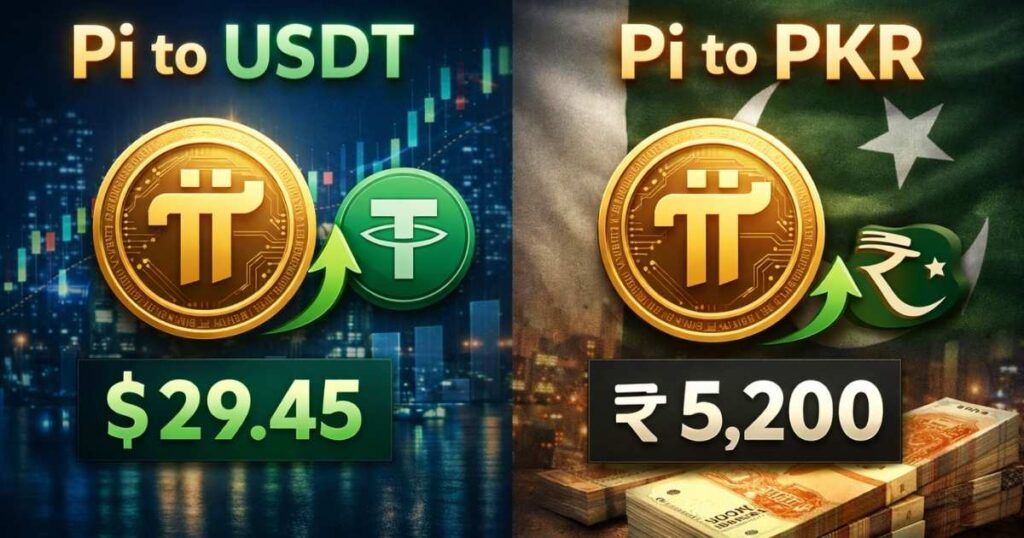
Here’s where things get confusing for a lot of people. When you check CoinGecko or CoinMarketCap and see a Pi Coin price, you’re often looking at IOU prices. These are not the same as the real open-market price of fully tradable mainnet Pi.
An IOU (I Owe You) token is essentially a placeholder. Some exchanges listed Pi before it was officially transferable, letting traders speculate on its future value. These prices spiked wildly during hype periods, sometimes showing Pi at prices that made no sense given actual trading volume or liquidity.
The PI to USDT exchange rate on Bitget reflects trades happening on that specific platform, but the liquidity there is thin compared to major coins. That means even small trades can move the price noticeably. The PI to PKR conversion adds another layer of volatility because the rupee itself has been unstable.
To get a realistic sense of Pi’s value, look at the actual 24-hour trading volume alongside the price. If volume is low, the listed price is unreliable. A coin might show a price of $40 but only have $200,000 in daily trading activity. That’s a red flag. Compare it to Bitcoin or Ethereum, which regularly post billions in volume. Pi’s figures are nowhere near that level yet.
The Current Regulatory Status of Crypto in Pakistan (State Bank Updates)
Crypto in Pakistan sits in a strange legal space. The State Bank of Pakistan has not issued outright permission for crypto trading, but it hasn’t fully banned it either. Multiple court cases and regulatory consultations have kept the situation shifting year by year.
The SBP has historically warned citizens against crypto, citing risks around money laundering and foreign exchange controls. However, Pakistan’s IT ministry and various government bodies have expressed interest in blockchain adoption and even crypto regulation frameworks. There’s a tug-of-war happening at the policy level.
Chainalysis ranked Pakistan among the top countries for grassroots crypto adoption in recent years. That tells you ordinary Pakistanis are trading regardless of regulatory ambiguity. People are using P2P platforms, local OTC desks, and international exchanges through VPNs to access markets.
What does this mean for you practically? It means crypto trading in Pakistan is not officially sanctioned, but it’s also not being aggressively prosecuted for individuals doing small transactions. Businesses are in a trickier position. For now, most retail users operate in a grey zone. Crypto compliance in Pakistan remains a developing topic, and things could change with new legislation.
Always keep records of your transactions. Use platforms that follow KYC and anti-money laundering standards. And stay updated because regulations here can shift with little warning.
Mainnet vs Testnet Pi: Which Coins Can You Actually Sell?
This is possibly the most important thing to understand before you try selling anything. Not all Pi is the same.
Testnet Pi is not real. It was used during Pi Network’s development phase to test functionality. If your app shows a balance but you haven’t completed KYC and migrated to mainnet, those coins cannot be transferred or sold. They have no market value and no exchange will accept them.
Mainnet Pi is what matters. To get there, you need to have completed identity verification through Pi Network’s KYC process, and your coins need to have been migrated to the mainnet blockchain. Even then, some Pi remains locked. Pi Network applies locking mechanisms to certain portions of your balance based on factors like mining bonuses, security circle rewards, and lockup period agreements you may have made during mining.
Your locked Pi balance cannot be transferred until the lock period expires. Only your unlocked, migrated mainnet Pi is actually sellable. Before you make any plans around how much Pi you can cash out, open your Pi app, go to your wallet, and check exactly how much is unlocked and available for transfer. Many users are shocked to find the freely available amount is far smaller than their total displayed balance.
Step-by-Step Guide: How People Attempt to Sell Pi Coin in Pakistan
Since Pi is not on Binance directly, here is the path that most Pakistani users follow right now. This is how to sell Pi Coin in Pakistan using the available infrastructure.
First, complete your Pi KYC and mainnet migration if you haven’t already. Without this, nothing else works. Open your Pi app and follow the wallet setup instructions to get a mainnet wallet address.
Second, create an account on Bitget. This is currently one of the most accessible exchanges with an active PI/USDT spot trading pair. Complete Bitget’s KYC process using your CNIC and other required documents. This is non-negotiable. Any exchange skipping KYC is a platform you should avoid.
Third, go to your Bitget account and find your Pi deposit address. Copy it carefully. One wrong character means lost funds.
Fourth, open your Pi mainnet wallet and initiate a transfer to your Bitget deposit address. Confirm the transaction. Wait for network confirmations, which can take time depending on network congestion.
Fifth, once Pi arrives in your Bitget account, go to the PI/USDT spot market and place a sell order. You can use a market order for instant execution or a limit order if you want a specific price.
Sixth, after selling Pi for USDT, you now have stablecoin in your Bitget wallet. You can either keep it there or transfer it to Binance using Binance’s internal transfer feature or a standard USDT withdrawal.
Seventh, once USDT is on Binance, use Binance P2P to sell USDT for Pakistani Rupees. Choose a trusted merchant, review their trade history and completion rate, and follow the P2P process carefully.
That’s the full chain. It’s not simple, but it’s the most reliable legal path currently available.
Using P2P Marketplaces to Convert USDT into Pakistani Rupees
The P2P crypto marketplace on Binance is where most Pakistani traders convert their digital assets into actual rupees. It works by connecting buyers and sellers directly. You post an offer or accept one, agree on a payment method, and complete the trade.
For Pakistani users, popular payment methods on Binance P2P include Easypaisa, JazzCash, bank transfers, and sometimes Raast. Once you place a sell order for USDT, the buyer sends PKR to your account through whichever method you agreed on, and you release the USDT from escrow.
Bitget also has its own P2P marketplace if you prefer keeping everything on one platform. The process is similar. Both platforms hold the crypto in escrow during the trade, which protects both parties.
Always trade with merchants who have a high completion rate, at least 95%, and a solid number of completed trades. Read feedback from other users. Never release USDT before confirming the PKR has actually arrived in your account. Scammers often send fake payment screenshots, so verify directly through your banking app, not through WhatsApp messages.
Risks of Black Market and OTC Pi Coin Swaps
Not everyone follows the exchange route. Some Pi holders in Pakistan turn to local OTC crypto swap services or informal peer-to-peer deals, often arranged through Telegram groups or WhatsApp communities. Someone offers cash for Pi, you transfer the coins, and they pay you directly. It sounds simple.
It is also extremely risky.
In informal OTC trades, you have zero protection. If the other person disappears after receiving your Pi, you have no recourse. No platform support. No escrow. Nothing. This happens constantly, and victims rarely recover their funds.
Beyond scams, OTC trading outside regulated platforms raises compliance concerns. If large amounts are involved, this could attract unwanted attention from financial authorities. Crypto phishing scams in South Asia have spiked alongside growing crypto interest. Many of these schemes start in community groups that appear legitimate.
The higher OTC price someone offers is almost always a manipulation tactic. They’re banking on your greed to lower your guard. Stick to platforms. The slightly lower rate is worth the protection.
How to Verify Exchange Listings and Avoid Fake Trading Pairs
Fake exchange listings are a real problem in the Pi community. People have lost money sending Pi to fraudulent platforms that mimicked legitimate exchanges in design and branding.
Before sending any Pi to an exchange, verify the listing on CoinGecko or CoinMarketCap. Search for Pi Network and check the official list of exchanges where it trades. If an exchange claims to list Pi but doesn’t appear on these aggregators, treat it with extreme suspicion.
Also verify the exchange’s domain carefully. Scammers create sites like “Bitg3t.com” or “Binance-pro.net” that look identical to real platforms. Bookmark official sites directly and never click exchange links from social media or messaging apps.
Check the trading volume on any listed pair. A genuine PI/USDT spot trading pair will show consistent volume data. If volume appears suspiciously high without market context, or if the pair shows strange price behavior, walk away.
Contact the exchange’s official support through verified channels before depositing anything significant for the first time.
Common Scams Targeting Pi Holders in Pakistan
Pakistani Pi holders face a specific set of scams that keep circulating through community groups. Knowing them helps you stay ahead.
The fake migration scam is common. Someone tells you that to complete your mainnet migration, you need to pay a small fee in USDT or PKR. Pi Network charges nothing for migration. Any fee request is a scam.
The Pi swap group scam works like this: someone in a Telegram group offers to buy your Pi at an above-market rate. They ask you to send Pi first. Once you do, they vanish. Always use escrow-based platforms.
The impersonation scam involves fake Pi Network support accounts on WhatsApp or Telegram. They claim your account has an issue and ask for your wallet passphrase or seed phrase. No legitimate service will ever ask for this. Your seed phrase is yours alone. Share it with nobody.
Investment pool scams promise to multiply your Pi if you send it to a “Pi earning wallet.” There is no such thing. Crypto sent to unknown wallets is gone forever.
Security Checklist Before Sending Pi to Any Wallet
Before you transfer a single Pi, run through this checklist.
Confirm the receiving wallet address twice, character by character. Use copy-paste and then verify the first and last six characters visually. Never type wallet addresses manually.
Make sure you’re using the official Pi mainnet wallet and not a third-party app claiming to be a Pi wallet. Stick to the wallet built into the Pi Network app.
Start with a small test transaction. Send a tiny amount first, confirm it arrives, and then send the rest. This one habit has saved people from losing entire balances.
Store your wallet seed phrase offline. Write it on paper and keep it somewhere safe. Do not photograph it. Do not save it in cloud storage or messaging apps.
Enable two-factor authentication on every exchange account you use. Use an authenticator app rather than SMS where possible.
Check the exchange withdrawal address is correct every single time. Some malware on devices replaces clipboard content with attacker addresses.
Should You Sell Now or Wait for Official Open Mainnet Launch?
This is the question every Pi holder is wrestling with. And honestly, there’s no single right answer because it depends entirely on your personal situation.
If you need the money now and Pi’s current price gives you something meaningful, selling a portion makes sense. Waiting for a higher price that may or may not come is a gamble. Crypto price volatility risk is real, and Pi’s market remains thin and unpredictable.
On the other hand, if you mined Pi for free and have no financial pressure to sell, holding until the open mainnet launch could be worth exploring. Pi Network’s team has been building ecosystem apps and growing merchant adoption. If that ecosystem gains traction after full launch, demand could grow.
What most experienced crypto participants suggest is a middle path. Sell a portion now to recover any opportunity cost or time investment. Hold the rest and see how the open mainnet changes things. Don’t go all-in on either extreme.
What you should absolutely not do is hold forever based on wild price predictions circulating in community groups. Those numbers are almost always speculative with no analytical backing. Make decisions based on your own financial reality.
FAQ’s
Can I sell Pi Coin directly on Binance?
Currently, Binance does not list Pi Coin for spot trading. You can sell Pi on platforms like Bitget and then move USDT to Binance for P2P conversion to PKR.
Is Pi Coin trading legal in Pakistan?
Crypto trading in Pakistan exists in a regulatory grey zone. The State Bank of Pakistan has not officially authorized it, but individual traders are generally not prosecuted for small transactions.
What is the current Pi Coin price in PKR?
Pi’s price fluctuates and the PKR value depends on the live PI/USDT rate plus current exchange rates. Always check CoinGecko for the most up-to-date pricing before trading.
How do I know if my Pi is on mainnet or still testnet?
Open your Pi app, go to the wallet section, and check if your coins have been migrated. If KYC is incomplete or migration hasn’t happened, your Pi is not yet on mainnet and cannot be transferred.
What should I do if I got scammed trying to sell Pi?
Report the incident to the platform if a platform was involved. Document everything including chat logs and transaction records. Reach out to Pakistan’s Federal Investigation Agency cybercrime division for formal reporting options.

Cole Maddox is a digital strategist and crypto content expert with over 7 years of experience in blockchain marketing and SEO. He specializes in creating data-driven content that builds trust and authority in the crypto space. Cole’s insights have helped startups grow organic reach through premium backlinks and high-quality guest posting strategies aligned with Google’s EEAT standards.