
If you’ve ever wondered who keeps Bitcoin running, the answer isn’t a company or a government. It’s miners, thousands of them across the globe running specialized machines nonstop. Bitcoin mining is the process that keeps the Bitcoin network secure and decentralized.
It verifies transactions, protects the system from fraud, and ensures no single authority controls the network. In this beginner’s guide, you’ll discover how bitcoin mining works, what equipment is required, and whether it’s still profitable today. Understanding how miners operate helps you see exactly why Bitcoin stands out in the world of digital money.
What Is Bitcoin Mining?
At its core, Bitcoin mining is the process of adding new transaction records to Bitcoin’s public ledger, the blockchain. But it’s also how new bitcoins enter circulation. Think of miners as the accountants of the Bitcoin network, except instead of sitting in an office, they’re solving complex mathematical puzzles at lightning speed.
Here’s the thing though. It’s not mining in the traditional sense. There’s no pickaxe involved. Instead, miners use powerful computers to compete against each other. The winner gets to add the next block of transactions to the blockchain and earns a reward in Bitcoin for doing so. It’s part lottery, part math competition, and entirely essential to how Bitcoin functions.
Why Mining Is Needed in the Bitcoin Network?
You might ask: why not just have a central authority record transactions? Banks do it all the time. The answer is trust, or rather, the elimination of it.
Bitcoin was designed so that no single person or institution controls the ledger. Without a trusted middleman, you need another way to agree on what’s true. Mining solves that problem. It creates a system where honesty is rewarded and cheating is made computationally expensive.
Every time someone sends Bitcoin, that transaction needs to be verified and permanently recorded. Mining does exactly that. It’s the engine that keeps the whole decentralized machine running.
Key Mining Concepts Explained Simply
Before going deeper, let’s define a few terms you’ll keep seeing.
| Term | What It Means |
| Block | A bundle of verified Bitcoin transactions |
| Blockchain | The full chain of all blocks ever created |
| Hash | A fixed-length code generated from data |
| Nonce | A number miners change to find a valid hash |
| Difficulty | How hard it is to find a valid block hash |
| Hash Rate | The total computing power on the network |
| Mempool | A waiting room for unconfirmed transactions |
These aren’t just buzzwords. Each concept plays a direct role in how Bitcoin mining works at a technical level.
What Role Does Mining Play in the Bitcoin Ecosystem?
Mining isn’t just one thing. It serves several critical functions simultaneously. Here’s a closer look at each.
Transaction Verification
When you send Bitcoin to someone, that transaction doesn’t instantly appear on the blockchain. First, it floats in the mempool, a kind of digital waiting room. Miners pick transactions from the mempool, verify they’re legitimate, and bundle them into a block. Once that block is confirmed, the transaction is permanently recorded. No bank approval needed. No waiting days for clearance.
Network Security
Every block that gets added to the blockchain requires enormous computational work. That work makes it practically impossible to alter past records. To change a confirmed transaction, you’d have to redo the computational work for that block and every block after it, simultaneously outpacing the rest of the network. That’s an astronomical task. This is what makes Bitcoin’s blockchain so secure.
Decentralization
No single miner controls the network. Thousands of participants worldwide compete to add blocks and so the power is spread out. This distributed crypto network design means there’s no single point of failure. No government can shut it down by targeting one company. No hacker can corrupt it by attacking one server.
Currency Issuance
New bitcoins don’t come from a central bank hitting “print.” They come from mining. Each time a miner successfully adds a block, the protocol creates new bitcoins and awards them to that miner. It’s a transparent, rule-based digital currency issuance process baked into Bitcoin’s code from day one.
Consensus Building
How does the entire network agree on which transactions are valid? Through mining. The Bitcoin network consensus mechanism means the longest chain, the one with the most computational work behind it, is accepted as the truth. Miners collectively enforce this rule without any central coordinator.
Proof-of-Work and Why It Matters
The mechanism behind all of this is called proof of work. It’s the beating heart of Bitcoin’s security model.
Here’s the idea. To add a block, a miner must prove they did significant computational work. That proof is the valid hash itself, a specific output that meets the network’s difficulty requirement. Anyone can instantly verify this proof. But producing it? That requires real energy and real hardware.
Proof of work security makes fraud extraordinarily costly. If someone wanted to rewrite Bitcoin’s history, they’d need to outspend the combined computing power of the entire network. In 2026, that’s an almost unthinkable amount of energy and investment.
Some critics argue proof of work is wasteful. Defenders counter that it’s precisely the “waste” that makes Bitcoin trustworthy. The energy isn’t thrown away, it’s converted into security.
Understanding Hashes in Bitcoin Mining
A hash is a digital fingerprint. Feed any data into a hashing algorithm and it spits out a fixed-length string of letters and numbers. Change even one character in the input and the output looks completely different.
Bitcoin uses the SHA-256 hashing algorithm. SHA stands for Secure Hash Algorithm. It takes any input, a transaction list, a timestamp, a random number, and outputs a 64-character string. Always 64 characters, no matter what you put in.
Here’s what makes this useful for mining. The hash is unpredictable. You can’t reverse-engineer the input from the output. You can’t predict what the output will be before you calculate it. So the only way to find a valid hash is to try billions of combinations until you stumble on one that works.
That’s exactly what mining computers do. Billions of guesses per second. Around the clock.
Target Hash and the Nonce Explained
Not just any hash will do. The network sets a target, a hash that must be below a certain value. Think of it like a lottery where your ticket number must start with a certain number of zeros. The more zeros required, the harder it is to win.
This is where the nonce comes in. The nonce (short for “number used once”) is a variable that miners change with each attempt. Everything else in the block header stays the same but miners tweak the nonce, rehash, and check if the result meets the target. If not, they try again. And again. Trillions of times.
When a miner finally finds a valid nonce, they’ve essentially won that round. They broadcast the block to the network and collect their reward.
How Bitcoin Mining Works Step-by-Step
Let’s walk through the full process clearly.
- Transactions are broadcast to the Bitcoin network and land in the mempool.
- A miner selects transactions from the mempool to include in a candidate block.
- The miner assembles a block header containing key data including the previous block’s hash.
- The miner begins the nonce guessing process, hashing billions of combinations.
- When a valid hash is found (one below the target), the miner broadcasts the block.
- Other nodes verify the block independently.
- The block is added to the blockchain and the miner receives the block reward plus transaction fees.
- The process repeats for the next block.
Simple in concept. Staggering in computational scale.
The Mechanics of Mining
Let’s go even deeper into what happens under the hood.
Understanding the Mempool
The mempool is Bitcoin’s waiting room. Every unconfirmed transaction sits here until a miner picks it up. During periods of heavy network usage, the mempool swells. Transactions offering higher fees jump the queue because miners naturally prioritize them, more fee means more profit.
During the 2021 bull run, mempool backlogs were so severe that users paid $50+ in fees just to move Bitcoin quickly. It’s a real market in action.
Constructing a Candidate Block
A miner doesn’t grab every transaction in the mempool. They build a candidate block, a proposed list of transactions they want to confirm. The goal is to maximize total fees within the block size limit (currently 1 MB for base layer transactions, more with SegWit).
Building the Block Header
The block header is the critical piece. It contains:
- The previous block’s hash (linking the chain)
- The merkle root (a hash representing all included transactions)
- A timestamp
- The current difficulty target
- The nonce
This header is what gets hashed repeatedly during mining computational work.
Comparing Against the Difficulty
After hashing the block header, the miner checks: is this hash below the current target? If yes, jackpot. If no, back to work. The mining difficulty adjustment ensures a new block gets found roughly every 10 minutes regardless of how much hash power is on the network.
Adjusting the Nonce
The nonce is 32 bits, which means it offers about 4 billion possible values. Modern ASIC mining machines can exhaust all those values in milliseconds. When that happens, miners change another field, like the timestamp or the set of included transactions, and start cycling through nonces again.
Broadcasting the Block
Found a valid hash? The miner immediately broadcasts the block to the network. Other nodes verify it independently and within seconds the new block joins the blockchain. The miner’s reward gets credited. And the race for the next block begins instantly.
Bitcoin Block Rewards and Incentives
Why would anyone spend thousands on hardware and electricity to mine? Because the block reward incentives are significant.
When a miner successfully adds a block, two things happen. First, the protocol creates new bitcoins and awards them to the miner. Second, the miner collects all the transaction fees from the transactions included in that block.
As of 2026, the block reward sits at 3.125 BTC per block following the 2024 halving. At current Bitcoin prices, that’s a meaningful payout. Multiply that by the roughly 144 blocks found per day and the total daily issuance becomes clear.
Transaction fee incentives are growing in importance too. As block rewards diminish over time through halvings, fees will eventually become the primary income for miners. This is by design.
How Mining Affects Bitcoin Supply
Bitcoin has a hard cap of 21 million coins. Not a policy. Not a law. It’s code. And mining governs how those coins enter circulation through a tightly controlled digital currency issuance process.
Every block releases a fixed amount of new Bitcoin. That amount halves roughly every four years. This predictable, diminishing issuance is what gives Bitcoin its digital gold scarcity model. Unlike fiat currency, no one can decide to print more. The rules are set.
Approximately 19.7 million bitcoins had been mined by early 2026 meaning only about 1.3 million remain to be issued. The final bitcoin won’t be mined until around 2140. By then, miners will rely entirely on transaction fees.
Bitcoin Halving and Its Impact on Miners
Every 210,000 blocks, roughly every four years, the block reward gets cut in half. This event is called the halving and it’s one of the most anticipated moments in the crypto calendar.
The mining reward halving impact is significant. Overnight, miners earn half as much Bitcoin per block. If prices don’t rise to compensate, some operations become unprofitable and shut down. This happened after the 2020 and 2024 halvings. The miners who survived were the most efficient ones.
Interestingly, halvings have historically preceded major bull markets. Reduced supply hits the market while demand keeps growing, basic economics then takes over. But there are no guarantees. Miners have to plan carefully.
Solo Mining vs Pool Mining
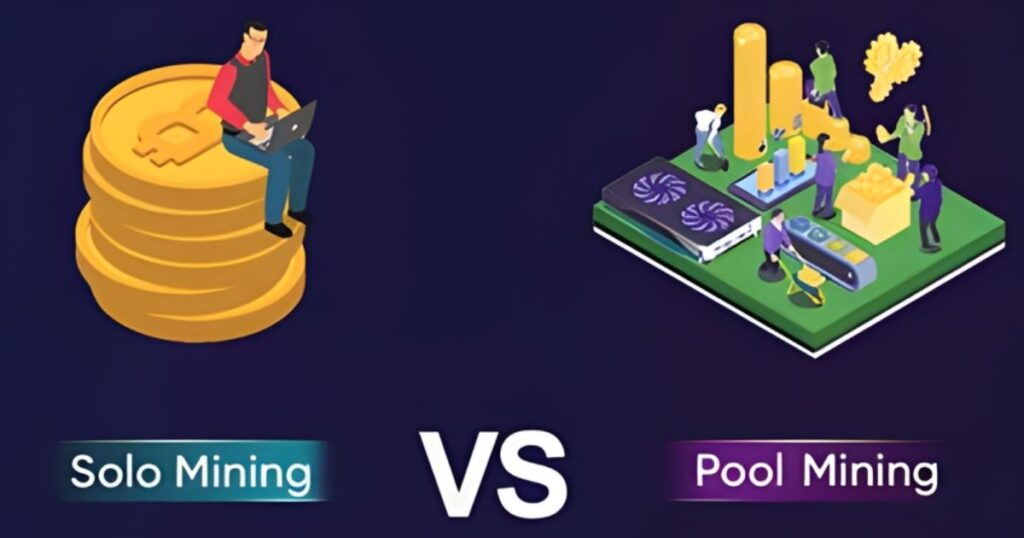
Here’s a question every new miner faces: go it alone or join a team?
Solo mining means your hardware competes against the entire network by itself. The odds of finding a block are tiny. You might wait years. But when you do find one, you keep the entire reward.
Mining pool participation flips that equation. You combine your hash power with thousands of other miners. The pool finds blocks far more often and you receive a share of the mining pool reward distribution proportional to your contribution. Less variance. Steadier income.
For most people starting out, mining pool participation makes far more financial sense. Solo mining profitability is essentially a lottery at this point unless you’re running an industrial-scale operation.
What You Need to Start Bitcoin Mining
Thinking about getting started? Here’s what you actually need.
Mining infrastructure setup involves more than just buying a machine. Here’s a realistic checklist:
- ASIC miner (e.g., Bitmain Antminer S21 or equivalent 2026 model)
- Stable, high-speed internet connection
- Adequate electrical supply (220V recommended for most ASIC units)
- Proper ventilation or crypto mining cooling solutions (ASICs run extremely hot)
- A Bitcoin wallet to receive rewards
- Mining pool account (unless solo mining)
- Mining software to manage and monitor your hardware
The mining hardware requirements for beginners are steep. A quality ASIC miner costs anywhere from $2,000 to $10,000+ in 2026. Add electricity costs and the barrier to entry is real.
Is Bitcoin Mining Profitable in 2026?
The honest answer is: it depends. Bitcoin mining profitability calculation involves several variables.
| Factor | Impact on Profitability |
| Bitcoin price | Higher price = more revenue per block |
| Mining difficulty | Higher difficulty = fewer blocks won |
| Hash rate of your machine | Faster machine = better odds |
| Electricity cost | Biggest operational expense |
| Pool fees | Typically 1–2% of earnings |
| Hardware cost | Upfront capital investment |
Mining electricity costs are the biggest killer. Miners in regions with cheap power, Iceland, parts of the US, Paraguay, have a massive edge. Renewable energy mining operations are increasingly common because cheap electricity directly determines survival.
Can Bitcoin mining be profitable in 2026? Yes, but only for those running efficient hardware in low-cost energy environments. It’s not a casual hobby anymore.
History of Bitcoin Mining Hardware
Mining hardware has evolved dramatically since 2009. Let’s trace that journey.
CPU Mining
In Bitcoin’s earliest days, you could mine using a regular laptop CPU. Satoshi Nakamoto himself mined the genesis block this way. CPU mining was slow but it worked when difficulty was near zero and there was almost no competition.
GPU Mining
By 2010, miners discovered that graphics cards (GPUs) could mine far faster than CPUs. GPUs are built for parallel processing, perfect for the repetitive hashing work mining requires. The GPU mining era kicked off an arms race.
FPGA Mining
Field-programmable gate arrays (FPGAs) came next. More efficient than GPUs and more customizable for mining tasks. They bridged the gap between consumer hardware and purpose-built mining chips.
ASIC Mining
Then came the game-changer. Application-specific integrated circuits, ASICs, are chips designed exclusively for Bitcoin mining. Nothing else. Their mining hardware efficiency is orders of magnitude beyond anything that came before. Modern ASIC mining machines can perform tens of terahashes per second while consuming relatively modest power.
Today, CPU and GPU vs ASIC mining is no contest. ASICs dominate entirely. If you’re serious about mining, an ASIC is the only viable option.
Security Risks and the 51% Attack
Bitcoin’s security isn’t theoretical. But it does have one known vulnerability worth understanding.
A 51% attack happens when a single entity controls more than half the network’s total hash power. With majority control, they could potentially rewrite recent transaction history, reversing transactions they made and spending the same coins twice. This is the double-spending problem that Bitcoin was designed to prevent.
How does mining prevent double spending? By making control this expensive. Acquiring 51% of Bitcoin’s hash rate in 2026 would require billions of dollars in hardware plus the ongoing electricity costs to run it. And even then, the attack would only last as long as you maintained majority control.
For Bitcoin specifically, a 51% attack is widely considered practically impossible given the sheer scale of the network. Smaller cryptocurrencies with lower hash rates are far more vulnerable.
The Future of Bitcoin Mining
Where is this industry heading? Several trends are shaping the future of proof of work mining.
Energy is the biggest conversation. Critics consistently raise Bitcoin mining environmental concerns and the data backs them up, Bitcoin does consume significant electricity. However, the industry is responding. Renewable energy mining is accelerating as miners chase the cheapest power sources, which increasingly means solar, hydro, and wind.
Hardware will keep improving. The mining hardware lifecycle gets shorter every cycle as manufacturers push efficiency boundaries. Miners constantly upgrade or risk falling behind on mining hash power competition.
Fees will matter more. As the block reward shrinks toward zero over coming decades, transaction fee incentives become the economic foundation for miners. A healthy, active Bitcoin network with robust transaction volume is therefore essential to long-term mining viability.
Regulation is tightening too. Crypto mining taxation rules are evolving rapidly across different jurisdictions. Serious mining operations need legal and tax counsel now more than ever.
Despite the challenges, the future of the Bitcoin mining industry looks resilient. As long as Bitcoin has value, someone has an incentive to mine it. That incentive keeps the network alive.
FAQ’s
How long does it take to mine one Bitcoin?
Solo mining one full Bitcoin could take years depending on your hardware. In a pool, you earn fractional amounts continuously based on your contributed hash power.
What is the best hardware for Bitcoin mining in 2026?
Top-tier ASIC miners from Bitmain, MicroBT, and Canaan lead the market. The Antminer S21 series and Whatsminer M60 series are strong performers for efficiency and output.
Is Bitcoin mining legal?
In most countries, yes. However, regulations vary significantly. Some nations restrict or ban it outright so checking your local laws before investing is essential.
How does mining prevent double spending?
Once a transaction is confirmed in a block and buried under subsequent blocks, altering it would require redoing all that computational work, an effectively impossible task at Bitcoin’s current scale.
What happens when all Bitcoins are mined?
Mining continues. Miners will earn only transaction fees once the 21 million supply cap is reached around 2140. Fee revenue is expected to sustain network security long-term.

Cole Maddox is a digital strategist and crypto content expert with over 7 years of experience in blockchain marketing and SEO. He specializes in creating data-driven content that builds trust and authority in the crypto space. Cole’s insights have helped startups grow organic reach through premium backlinks and high-quality guest posting strategies aligned with Google’s EEAT standards.