
If you’ve been exploring ways to make your crypto work harder for you, chances are you’ve come across BlockFi. Maybe a friend mentioned it, or you stumbled across it while searching for crypto savings accounts or Bitcoin lending platforms. Either way, you’re probably wondering: is BlockFi actually legit? Is it safe to trust it with your crypto?
Those are fair questions. The crypto space has had its share of platforms that promised the world and delivered nothing. So before you move a single satoshi, it makes sense to dig deep into what BlockFi actually offers, how it operates, and whether the risks are worth taking.
This review covers everything, from how the platform works and what kind of interest rates you can expect, to its security track record, customer support quality, and how it stacks up against Coinbase. By the end, you’ll have a clear picture of whether BlockFi belongs in your financial toolkit or not.
BlockFi General Info
BlockFi is a U.S.-based financial services company built specifically for the cryptocurrency world. Think of it as a hybrid between a crypto bank and a lending platform. It lets you earn interest on your crypto holdings, take out crypto-backed loans, trade digital assets, and even earn crypto rewards through a Visa credit card.
The platform markets itself as a way to make your digital assets more productive. Rather than letting your Bitcoin or Ethereum sit idle in a wallet, BlockFi lets you put those assets to work, earning yield, serving as collateral, or being exchanged for other coins.
It’s worth noting that BlockFi went through some significant turbulence in 2022. The platform faced regulatory pressure, including a landmark SEC settlement, and later filed for bankruptcy protection after the collapse of FTX. These events are important to understand before you consider using the platform. We’ll cover them in detail throughout this review.
Read More: Beste Kryptowährungen 2026: Expertenanalyse, Prognosen & Top Picks
Founders, History, and Company Growth
BlockFi was founded in 2017 by Zac Prince and Flori Marquez. Prince came from a background in consumer lending and fintech, while Marquez brought experience from the startup and venture capital world. Together, they spotted a gap in the market: crypto holders had significant assets but almost no way to earn passive income on them or borrow against them without selling.
The company launched its flagship product, an interest-bearing crypto account, in early 2019. The timing was smart. Institutional and retail interest in cryptocurrencies was surging, and traditional banks weren’t touching digital assets with a ten-foot pole.
BlockFi grew fast. By 2021, the platform had amassed over 450,000 funded accounts and managed more than $10 billion in assets. It raised hundreds of millions in venture capital funding from some well-known investors, including Coinbase Ventures, Bain Capital Ventures, and Tiger Global.
But 2022 brought serious challenges. In February of that year, the SEC announced that BlockFi would pay $100 million to settle charges related to its interest accounts, which regulators argued were unregistered securities. That settlement forced the company to restructure its U.S. offerings significantly. Then, in November 2022, following the collapse of FTX, which had extended a credit line to BlockFi, the company filed for Chapter 11 bankruptcy protection.
BlockFi layoffs 2022 were significant, and the platform’s future became deeply uncertain. The company has since been working through bankruptcy proceedings, and its availability and features have been impacted. This review reflects the platform as it was structured before those events, with relevant caveats noted where applicable.
BlockFi Key Features

Despite the legal and financial turbulence, BlockFi built a genuinely interesting set of products during its peak. Understanding these features gives you a sense of what the platform set out to do, and what kinds of services you might see from the next generation of crypto lending platforms, many of which have taken inspiration from BlockFi’s model.
Interest-Saving Accounts
This was BlockFi’s most popular product, and honestly, it’s easy to see why. The BlockFi Interest Account (BIA) let you deposit crypto and earn compounding interest on it, monthly, automatically, with no lock-up periods initially required.
It worked a lot like a high-yield savings account, but for crypto. You’d deposit your Bitcoin, Ethereum, or stablecoins, and the platform would lend those assets out to institutional borrowers. In return, you’d receive a portion of the interest earned. Simple enough in concept, though the risks involved were anything but simple.
Interest Rates & Insurance on Interest
BlockFi offered some genuinely competitive interest rates at various points. Stablecoin APY on assets like USDC or USDT could reach upward of 9% at certain times, while Bitcoin and Ethereum rates were more modest but still well above anything a traditional savings account would offer.
However, it’s crucial to understand something: these accounts were not insured the way a bank deposit would be. There is no FDIC insurance alternative that fully covers crypto holdings. BlockFi did maintain crime insurance to protect against theft and hacking, but that’s a different animal altogether. If BlockFi itself became insolvent, which is exactly what happened, account holders could lose their deposits. That risk materialized in 2022, and many users found themselves as unsecured creditors in the bankruptcy proceedings.
The platform also employed institutional-grade custodians and claimed to never hold client assets in uninsured locations, but these assurances only go so far when the underlying business model faces systemic collapse.
BlockFi’s Plans for the Future Pertaining to Interest Bearing Accounts
Before the bankruptcy filing, BlockFi had outlined ambitious plans for expanding its interest-bearing crypto offerings. The company had been working on complying with SEC requirements to restructure its interest product as a registered security, what it called the BlockFi Yield product for new U.S. customers.
The idea was to maintain the core value proposition, earning yield on crypto, while meeting regulatory standards. For existing customers outside the U.S., the original BIA was still accessible with its existing rates and structure. Whether these plans will ever come to fruition remains uncertain given the bankruptcy proceedings.
Unavailable in the U.S.
Following the SEC settlement, BlockFi’s Interest Account became unavailable to new U.S. users. Existing U.S. account holders were grandfathered in under specific conditions, but the platform could no longer onboard new American residents into the interest product.
For non-U.S. investors, the product remained available in many jurisdictions. This created a two-tier experience on the platform, where geography determined what features you could actually access. It’s a stark reminder of how regulatory environments shape what crypto platforms can offer in different markets.
Lending Services
BlockFi’s lending arm was another standout feature. Rather than selling your crypto to access cash, you could pledge your digital assets as collateral and receive a U.S. dollar loan. This is crypto-backed loans in practice, a concept that’s become increasingly popular across the industry.
The appeal is obvious. If you believe Bitcoin is going to appreciate long-term, selling it to cover a short-term expense feels like leaving money on the table. A collateralized loan lets you access liquidity without triggering a taxable event from selling your crypto holdings.
Loan-to-Value (LTV) and Interest Rates
BlockFi offered loan-to-value ratios starting at around 50%, meaning you could borrow up to 50% of your collateral’s value. So if you pledged $20,000 worth of Bitcoin, you’d receive up to $10,000 in loan proceeds. The platform also offered lower LTV options like 20% or 30% for borrowers who wanted more breathing room in case the market dropped.
The interest rates on these loans were competitive compared to traditional personal loans, generally ranging from around 4.5% to 9.75% annually depending on the LTV ratio selected. Lower LTV meant lower interest, the platform rewarded you for putting up more collateral relative to what you borrowed.
One major risk: if your collateral’s value dropped below certain thresholds due to crypto market volatility, BlockFi could issue a margin call or automatically sell a portion of your collateral. This is a real danger in a volatile market, and it caught some borrowers off guard during sharp downturns.
Tax-Related Advantages
One of the most underappreciated aspects of crypto-backed loans is the potential crypto tax benefits involved. When you borrow against your crypto instead of selling it, you don’t trigger a capital gains event. That means no immediate tax bill on any appreciation your assets may have accumulated.
This isn’t a loophole, it’s how collateralized borrowing has always worked, in crypto and in traditional finance. You’re not selling an asset; you’re pledging it. The tax implications of borrowing crypto aren’t zero, you still need to track your positions carefully, but the deferral of capital gains can be a meaningful advantage for long-term holders with highly appreciated assets.
Always consult a tax professional who understands crypto before making decisions based on these potential advantages. Tax law in this space is still evolving rapidly.
BlockFi Rewards Visa® Signature Credit Card
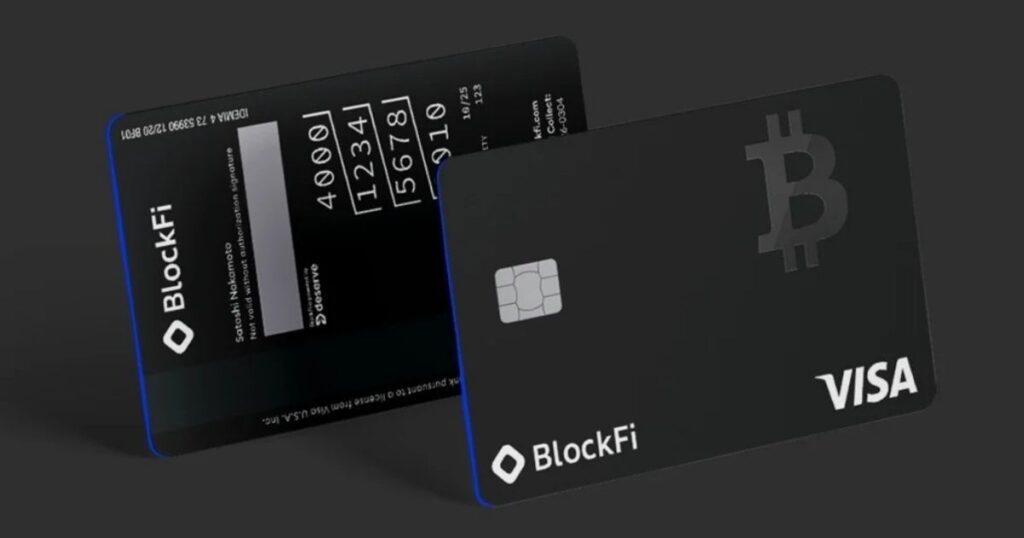
This was one of BlockFi’s most talked-about products, a crypto credit card that let you earn Bitcoin rewards on everyday purchases. No annual fee, no exotic requirements, and rewards paid in actual cryptocurrency rather than airline miles or cashback points.
Key Benefits and Crypto Rewards
The BlockFi Rewards Visa Signature card earned 1.5% back in Bitcoin on every purchase, with a boosted 2% rate after spending $30,000 in a calendar year. There were also bonus categories: 3.5% back in crypto on purchases made in the first 90 days, up to $100 in Bitcoin for trading on BlockFi, and unlimited 2% back in stable coins on eligible purchases.
Rewards were deposited directly into your BlockFi account monthly, where they could then earn interest, a nice compounding effect if you let the rewards accumulate. The card also came with no foreign transaction fees, which is a genuine perk for frequent travelers.
In terms of crypto credit card bonuses, this card was among the most straightforward and generous on the market during its active period. No complex point systems. No conversions. Just Bitcoin, deposited automatically.
BlockFi Credit Card Drawbacks
The card wasn’t without its downsides. To qualify, you needed a strong FICO credit requirement, typically 750 or higher, which excluded a large portion of potential applicants. The card was also only available to U.S. residents, cutting off international users who might have been interested.
There was no traditional cashback option if you didn’t want your rewards in crypto, which could frustrate applicants who were crypto-curious but not fully committed. The crypto credit limit also wasn’t customizable beyond standard credit approval processes, which some users found limiting. And of course, the value of your Bitcoin rewards fluctuates with the market, so if prices drop right after you earn rewards, the real-world value of those rewards drops too.
BlockFi Crypto Exchange
Beyond savings and lending, BlockFi also operated a simple cryptocurrency exchange. It wasn’t designed to compete with full-featured platforms like Binance or Coinbase Pro. Think of it as a clean, straightforward way to swap one crypto for another within the BlockFi ecosystem.
Supported Cryptocurrencies
BlockFi’s exchange supported a focused roster of digital assets. At various points, this included Bitcoin, Ethereum, Litecoin, Chainlink, Paxos Gold, and several stablecoins including USDC, USDT, BUSD, and PAX. It wasn’t as expansive as a dedicated digital asset exchange, but it covered the most commonly held assets in most retail cryptocurrency portfolios.
The selection was intentional. BlockFi positioned itself as a platform for serious, longer-term crypto investors, not for day traders or speculators chasing micro-cap tokens. If you wanted to hold, earn, and borrow, the supported coins were more than adequate. If you wanted access to hundreds of altcoins, you’d need to look elsewhere.
Recurring Trades Feature
One underrated feature was BlockFi’s recurring trades functionality. Similar to dollar-cost averaging strategies offered by some robo-advisors, this let you automate crypto recurring purchases on a set schedule, daily, weekly, or monthly.
For anyone who believes in long-term crypto investing but doesn’t want to time the market, this was genuinely useful. You’d set it up once, fund your account, and the platform would automatically purchase your chosen cryptocurrency at your preferred frequency. It removes emotion from the equation, which for volatile assets like Bitcoin or Ethereum, is often a very good thing.
BlockFi Security
Security is non-negotiable when you’re talking about a platform that holds your crypto assets. This is where things get nuanced with BlockFi, it made meaningful investments in security infrastructure, but it also experienced real breaches.
Security Measures and Cold Storage
BlockFi used Gemini Trust Company as its primary custodian for crypto assets. Gemini is a regulated U.S. exchange with SOC 2 Type 2 certification and holds the majority of customer funds in cold storage wallet arrangements, meaning assets are kept offline and away from internet-connected systems.
The platform also employed two-factor authentication for all user accounts, crypto account allowlisting to restrict withdrawals to pre-approved addresses, and layered access controls to limit internal exposure. These are industry-standard measures, and BlockFi implemented them reasonably well.
That said, cold storage security only protects against one category of risk. It doesn’t protect against platform insolvency, poor business decisions, or counterparty failures, all of which became relevant in BlockFi’s case.
Previous Hacker Attacks
BlockFi has experienced data breaches. In May 2020, a SIM-swapping attack targeted a BlockFi employee, giving hackers temporary access to a marketing tool. The attackers obtained some user data, including names, email addresses, dates of birth, and physical addresses. No funds were directly compromised in that incident, but user data was exposed.
Later, in 2022, BlockFi was listed among the victims of a data breach at one of its marketing vendors. Again, no direct fund theft occurred, but user contact information was accessed.
These incidents aren’t minor. They highlight the fact that crypto platform security isn’t just about protecting wallets, the entire ecosystem around a platform, including third-party vendors, represents potential vulnerabilities. BlockFi’s response to these incidents was generally prompt, with notifications sent to affected users and improved vendor oversight announced afterward.
BlockFi Customer Support
Support quality can make or break your experience on any financial platform. When things go wrong, and in crypto, things go wrong, you want to know that help is accessible and effective.
Help Center and Support Channels
BlockFi offered a comprehensive help center on its website, covering everything from account setup to loan management, trading, and tax documentation. The documentation was generally well-organized and kept reasonably up to date.
Beyond the self-service resources, BlockFi offered crypto user support through email and live chat. Phone support was not widely available, which frustrated users who preferred speaking to a person directly. The live chat was available during business hours, with response times that varied depending on support volume.
User Reviews and Response Times
User sentiment around BlockFi’s support was genuinely mixed. On third-party review platforms, you’d find users praising the platform for clear communication and helpful documentation, while others complained about slow response times, particularly during periods of high market activity or when the platform was navigating regulatory issues.
One recurring theme in negative reviews: support response times ballooned significantly during the turbulent events of 2022. As the SEC settlement and subsequent bankruptcy proceedings created uncertainty, support queues grew and many users reported waiting days for responses to urgent account inquiries.
That gap between ordinary support experience and crisis-period support experience is important to factor in when evaluating any crypto platform. The real test of customer service is how it performs under pressure, and by that measure, BlockFi’s support showed real limitations.
BlockFi vs. Coinbase
Comparing BlockFi to Coinbase is a bit like comparing a boutique financial services firm to a full-service bank. They overlap in some areas but serve meaningfully different use cases.
Fees Comparison
Coinbase is well-known for its relatively high crypto transaction fees on the standard consumer platform. Trading fees can reach 1.49% or higher for basic trades, though Coinbase Pro (now Coinbase Advanced Trade) offers significantly lower rates for more active traders.
BlockFi’s exchange charged a spread, typically around 0.1% to 1% depending on the asset and size of the trade, rather than an explicit fee. This made cost comparison a bit tricky, since you needed to factor in the spread when calculating your real cost.
For lending and savings, Coinbase doesn’t offer anything comparable to BlockFi’s loan products. Coinbase does have some yield features, including staking rewards and a modest savings option for certain stablecoins, but the range is far narrower.
Supported Cryptos and U.S. Accessibility
This is where Coinbase has a clear advantage. Coinbase supports hundreds of cryptocurrencies and is available across all U.S. states without the regulatory restrictions that have impacted BlockFi’s product availability. For anyone who wants to explore a wide cryptocurrency portfolio across many different assets, Coinbase is the more versatile choice.
BlockFi’s supported list was intentionally curated and smaller, which is fine if you’re primarily interested in Bitcoin, Ethereum, and stablecoins, but limiting if you want access to the long tail of altcoins.
Savings Accounts and Interest Rates
This is where BlockFi had, at its peak, a genuine edge. The stablecoin APY on BlockFi’s interest accounts could reach into the high single digits, significantly higher than what Coinbase offered through its own yield products. For users primarily interested in earning passive income on crypto, BlockFi was often the better choice, at least until regulatory and financial problems changed the equation dramatically.
Coinbase, being more tightly integrated with U.S. regulatory frameworks, has generally offered more modest yield opportunities in exchange for greater perceived stability and availability.
Pros and Cons of Using BlockFi
Every platform has its trade-offs. Here’s a clear-eyed look at where BlockFi delivered and where it fell short.
On the positive side, BlockFi offered genuinely competitive interest rates on crypto savings at its peak, particularly for stablecoins. The crypto-backed loan product was innovative and useful for long-term holders who didn’t want to sell. The recurring trades feature made automated investing easy and accessible. The Rewards Visa card was among the best crypto credit card options available in the U.S. during its active period. And the platform’s security infrastructure, using Gemini as custodian, cold storage, two-factor authentication, was thoughtfully built.
On the negative side, the lack of FDIC insurance or a meaningful equivalent means your deposits carry real default risk, as 2022 made devastatingly clear. The U.S. restrictions on the interest account significantly reduced the platform’s appeal for new American users. Customer support became unreliable during periods of stress. The supported cryptocurrency list was limited compared to full exchanges. And the bankruptcy filing has cast a long shadow over the platform’s reliability and future prospects.
The honest summary: BlockFi built genuinely interesting products but took on structural risks that ultimately proved fatal. The lessons from its rise and fall are worth understanding regardless of which platform you ultimately choose.
Summarization
BlockFi was, at its core, a bold experiment in bringing traditional financial services concepts, savings accounts, lending, credit cards, into the crypto world. For a while, it worked remarkably well. The interest rates were real, the loan product was useful, and the credit card was a genuinely clever on-ramp for crypto curious consumers.
But the risks were always present. The lack of regulatory clarity around interest-bearing crypto accounts created a ticking clock. The reliance on institutional counterparties like FTX introduced systemic vulnerability. And the absence of deposit insurance meant that when things went wrong, ordinary users bore the brunt of the consequences.
If BlockFi or a successor platform emerges from bankruptcy and rebuilds, the features it pioneered will likely serve as the blueprint. Crypto savings, collateralized borrowing, and crypto-linked credit cards aren’t going away, they’ll just be built on firmer regulatory and financial foundations next time.
For now, if you’re considering a platform that offers similar features, do your due diligence. Look at how funds are held, what regulatory oversight exists, and what happens to your assets if the platform faces financial trouble. BlockFi’s story is a reminder that in crypto, the highest yields often come with the highest risks.
FAQ’s
What is BlockFi and how does it work?
BlockFi is a crypto financial services platform that lets users earn interest on digital assets, take out crypto-backed loans, trade cryptocurrencies, and earn Bitcoin rewards through a Visa credit card. It works by lending your crypto to institutional borrowers and sharing the interest earned with you.
Is BlockFi safe to use?
BlockFi implemented strong security measures including cold storage custody through Gemini, two-factor authentication, and withdrawal allowlisting. However, the platform filed for bankruptcy in 2022, which exposed the risks of platform insolvency that security measures alone cannot protect against.
Why did BlockFi shut down its U.S. interest accounts?
Following an SEC settlement worth $100 million in February 2022, BlockFi was required to stop offering its interest accounts to new U.S. residents, as regulators determined the product constituted an unregistered security.
How does BlockFi compare to Coinbase?
Coinbase supports more cryptocurrencies and is more accessible across the U.S., while BlockFi offered higher interest rates on savings and crypto-backed loan products that Coinbase doesn’t provide. For trading variety, Coinbase wins; for yield products, BlockFi had the edge before its bankruptcy.
Can you still use BlockFi today?
BlockFi filed for Chapter 11 bankruptcy in November 2022 and has been working through proceedings since then. The platform’s availability and features have been significantly impacted, and users should check the latest status directly before attempting to use or fund an account.

Cole Maddox is a digital strategist and crypto content expert with over 7 years of experience in blockchain marketing and SEO. He specializes in creating data-driven content that builds trust and authority in the crypto space. Cole’s insights have helped startups grow organic reach through premium backlinks and high-quality guest posting strategies aligned with Google’s EEAT standards.